


Where our (technical) articles have a very rigorous tone, this article is specifically intended to give a short, gentle and accessible introduction to Model Thinking by answering 6 important questions.
However, some concepts can only be truly understood through firsthand experience. You can explain the benefits of swimming, but to truly grasp its joy, one must get in the water. We believe the same is true for Model Thinking: its full depth and power are only revealed when you engage with it directly.
1. What is Model Thinking?
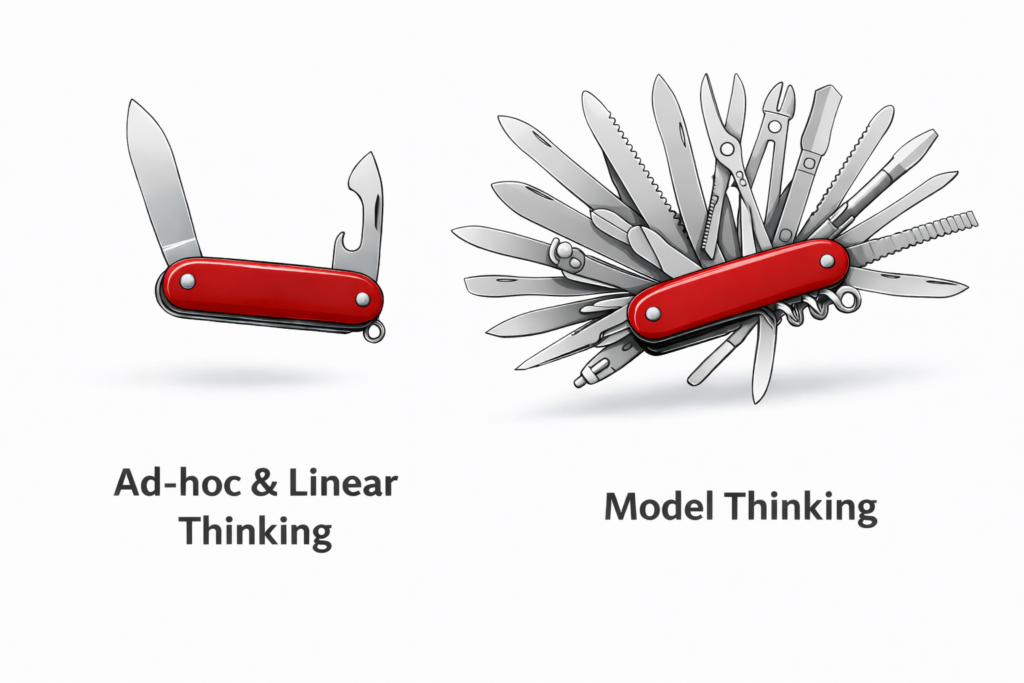
Model Thinking is a way of thinking that is rooted in the use of models, methodologies and frameworks instead of the ad‑hoc or purely linear reasoning we naturally default to.
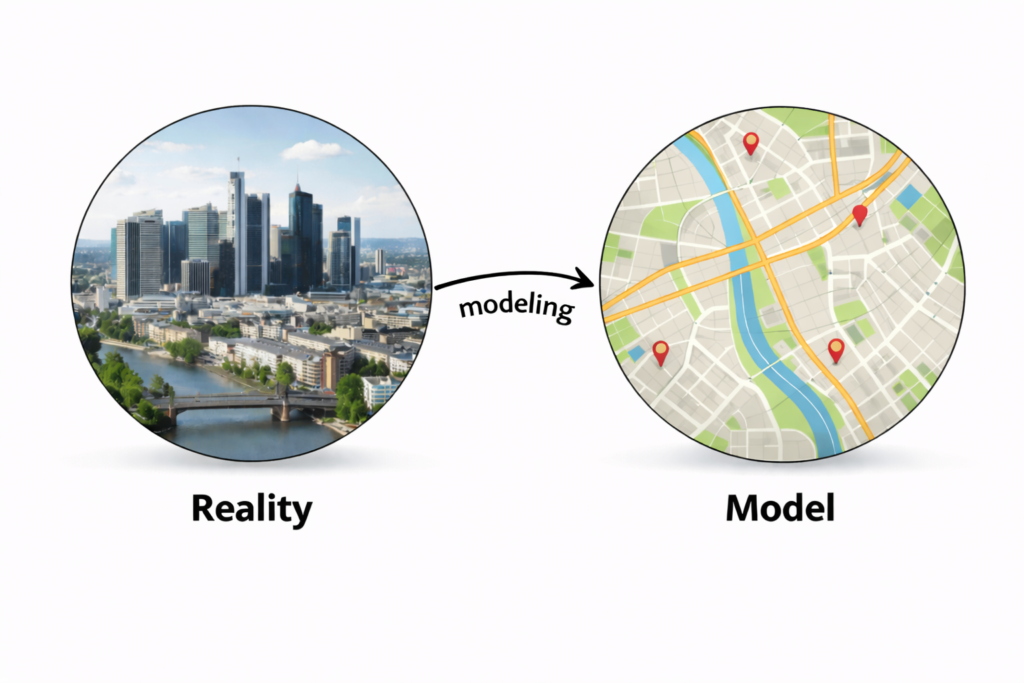
While Model Thinking represents a deep philosophy, the core idea is simple: We capture reality in a simplified representation—a model—that makes complex situations easier to understand and navigate, without losing key information and insights. Instead of guesses, sentiments or gut feelings, we use these structured tools for analysis, guidance and decision making.
Very important is that models are not static! They are intended to be updated and refined with knowledge and experience. Model Thinking therefore also offers a structured approach to growth and self-development.
2. Why are models so useful and what are the benefits of Model Thinking?
In many cases, reality is too complex to engage with directly, so it must first be captured in simplified representations. Model Thinking is therefore a necessary discipline for managing complexity and reasoning about contexts, systems, and uncertainties—offering sophisticated yet practical tools. The benefits are numerous:
-
Learn proven tools, concepts, and techniques that deliver value in real-world applications.
-
Understand complex contexts more quickly and accurately.
-
Make stronger inferences, predictions, and decisions.
-
Continuously improve by systematically evaluating expectations against real-world outcomes.
This is why models are central to decision-making in leading corporations. On a personal level, many of us probably also know people who think in models. They stand out from the crowd, as if their minds work completely differently—more refined and effective.
3. What are examples of models?
Models appear everywhere in our daily lives, we have given some examples in the table below:
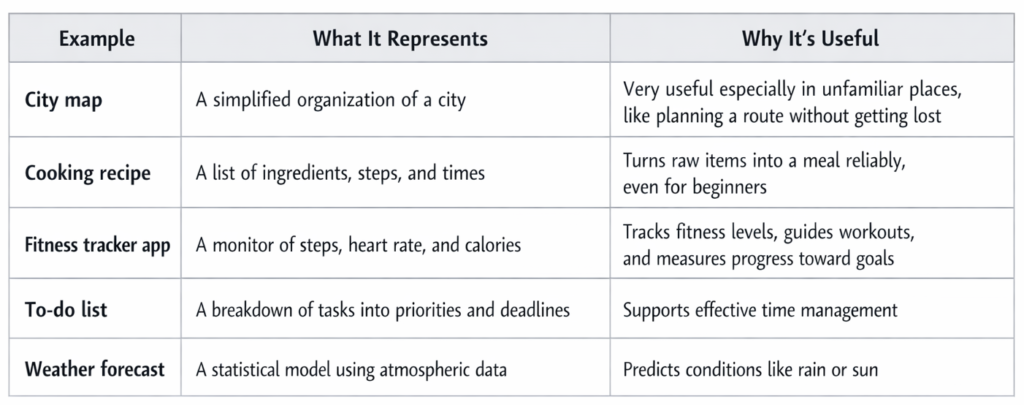
So when we look closely, we find out we already heavily make use of and rely on models that can be quite intuitive even for complex situations. Even AI is essentially a complicated model!
4. Does Model Thinking relate to concepts we might already know?
It’s always worth asking if a new concept relates to concepts we already know under different names. Model Thinking could, for example, also be described as Scientific Thinking, as science is built on creating models with structures and assumptions that are updated with experimental evidence.
The scientific method also needs to be refined and disciplined as it deals with complexity. Likewise, as science creates technologies, our experience-based models are a form of technological development—they provide more sophisticated tools and solve problems we once struggled with.
5. How does Model Thinking help deal with challenges faced within organizations?
This question provides a key but also practical example of what Model Thinking constitutes. Let’s look at different levels:
Team Level
Knowingly or unknowingly, managers are in search of (organizational) models that lead to better performance and cohesion. This is not that different from a football coach looking for the best formation and starting line-up. Without rigorous and powerful approaches, managers tend to operate more ad hoc, designing organizations based on what feels right rather than on a full understanding of all relevant factors. As a result, they have less control over complexity, and outcomes become sub-optimal, with much more reliance on luck and a favourable environment. This also explains why, when the environment becomes adverse, many managers are exposed and replaced.
Individual Level
At the individual level, we also by default operate on ad-hoc models in the form of beliefs. These beliefs are too simplistic—such as that hard work is always rewarded or that in an organizational context only rational considerations matter. As these beliefs are unrealistic in most cases, they misguide judgment and action, harming well-being and leading to frustration. A key reason people seek corporate training, for example, is to address this.
Success within organizations starts with updating one’s models of the context. It is a complex and political environment with biases that can favour factors like corporate connections, likability and appearance over pure performance. It is an arena where smart tactics and patience are necessary for breakthroughs. It is therefore unfortunate that most training programs overlook these core considerations and, as a result, offer little value.
Corporate Level
A company, just like any other complex system, tends to settle into some equilibrium in the form of a rationality. Such a complexity requires deep insight and powerful tools to elevate it into a higher mode of operation and performance.
6. Could I also follow this course elsewhere?
Our Model Thinking framework is built upon proven methods from the academic and corporate world, and we have learned especially from observing skilled practitioners. On this solid foundation, we have incorporated a wide range of practical and didactic innovations. As a result, our overall philosophy—both in content and delivery—is distinctly our own. We believe our approach is uniquely effective, and its form and style cannot be found elsewhere, which is why we consider it our proprietary framework.
Overall Summary
Model Thinking offers a more sophisticated and realistic way of understanding the world—one that is rooted in the use of models. Models are simplified representations of reality that help us make sense of complexity and are continuously updated based on new experiences and information. In fact, we already rely on models in our daily lives, and as the complexity of our environment and decisions increases, so does our need for more advanced model use. This is why successful large corporations and their leaders are, in essence, Model Thinkers. Even artificial intelligence itself is a complex model.
Within corporate environments, we also operate within (organizational) models. Improving performance—whether at the individual, team, or company level—requires a good understanding of these models and how to operate within them, and eventually how to transition to better models with greater alignment to elevate the performance.
Model Thinking, as we teach it, represents a distinct and proprietary framework that embodies this way of reasoning and applies it in a structured, practical manner.
Additional
You can find a more extensive introduction here.
Also see our promo below: