


In this article, we follow up on our claim that the principles and lessons of Sun Tzu and Clausewitz—central to the series of talks we will be hosting—are vital for making sense of the currently rapidly changing world. Beyond providing didactic tools and a deeper understanding of strategy, they can and should also guide business and investment decisions.
The US-Israel war with Iran
Earlier this year, the US and Israel launched a surprise attack on Iran following a prolonged period of negotiations and military build-up, marking the second war with Iran in two years. After what was termed the 12-day war of 2025, this conflict represents a second phase—one that has been significantly greater in scale, destruction, and global impact.
While the general trajectory of such a conflict and its broader global consequences had been anticipated by various geopolitical analysts, the exact timing, triggers, and intensity came as a surprise, particularly to the general public. Notably, the strategic importance and vulnerability of the Strait of Hormuz were underestimated by most analysts.
Likelihood of the war and investment strategy
While we had already anticipated by the end of 2024 that a war between Israel and Iran was increasingly likely—given developments in the Middle East over the past decades, particularly in recent years, as well as the gradual shift in global power away from the US toward Asia and the BRICS—the 12-day war nevertheless took an unexpected course and significantly impacted the worldview of many. In particular, this war set new precedents for modern warfare and clearly demonstrated the limitations of defensive interceptor missile systems, highlighting the vulnerability of air-defense systems to (Iranian) missile capabilities.
Following the 12‑day war, many analysts predicted a resurgence of conflict in the near future. This could be understood through frameworks such as those of Clausewitz, as the war itself did not resolve many of the underlying political contradictions and in fact exacerbated several of them. To better understand the dynamics of this complex situation, we used the past winter to study Sun Tzu, Clausewitz, and related strategic frameworks, while also developing models for what we saw as an impending escalation.
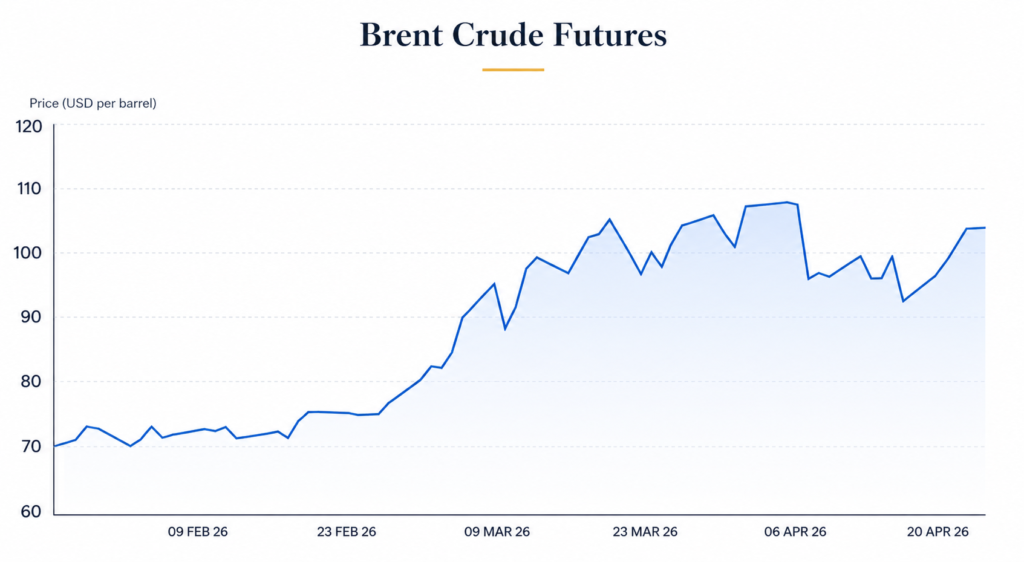
Particularly, by understanding the impact that a resurgence of the conflict would have on oil prices, we developed and implemented an investment strategy involving oil futures. Futures are agreements to buy or sell an underlying asset at a predetermined price at a specified point in the future. If one wishes to speculate on or hedge exposure to a particular resource or asset without physically purchasing it, futures contracts can be used. By closing positions before maturity, one can realize gains or losses based on price movements without taking physical delivery of the asset.
See below for an image of the movement in these futures (source: ice.com). We cannot present the actual realized returns, as most positions have not yet been closed. This is because we anticipate that current price levels are still too low, as we will elaborate on later in this article.
Iran, modern warfare and the strait of Hormuz
A distinction needs to be made between the concepts of war and warfare: war refers to the state of armed conflict, while warfare refers to the way in which that conflict is conducted. War is largely constant in its underlying nature, whereas warfare evolves continuously with new ideas, technologies, and capabilities. As such, a party that can correctly anticipate—or even define—the dominant form of warfare gains a decisive advantage.
Looking at the course of the two wars, and particularly the ongoing conflict, many have been surprised by the ability of Iran—a country that has been under heavy sanctions since 1979 and is, in conventional terms, far weaker than the United States in military capabilities—to withstand sustained pressure and eventually seize the strategic initiative. This illustrates the power of strategic depth and reflects Sun Tzu’s emphasis on “winning through stratagem” rather than relying on brute force.
In this light, one could argue that Iran has significantly shaped aspects of contemporary warfare by effectively developing and deploying relatively low-cost systems—such as kamikaze drones (e.g., the Shahed series)—against far more expensive military assets, including multi-billion-dollar aircraft carriers and advanced defense systems. This contrast highlights how certain high-cost systems may be less effective within an evolving model of warfare and suggests that parts of the traditional defense-industrial base may be insufficiently adapted to these changes.
In particular, Iran’s use of the potential closure of the Strait of Hormuz—a narrow maritime chokepoint through which a significant share of global oil, as well as other critical resources such as fertilizers and helium, flows—has proven to be a strategically powerful lever. This was a move we had anticipated, as outlined in the previous section, and it underscores how control over key chokepoints can generate disproportionate global impact.
Irrationalities and Distortions in Markets
The ongoing tragic conflict has not only significantly altered views on modern warfare and global power balances but has also demonstrated a range of remarkable and unexpected behaviours in financial markets, most notably in the oil market.
We would like to outline a few of these market distortions and inefficiencies:
Market manipulation: Based on trading data prior to major announcements, such as a reported two-week ceasefire announcement, it appears quite likely that trading took place based on information from political insiders—a claim that has also attracted attention from major news platforms. This suggests that certain political decisions may have been linked to personal gain, while also being used to suppress short-term oil prices.
Overvaluing unreliable information: Furthermore, when considering market irrationality, one has to acknowledge that markets often have reacted strongly to announcements from Donald Trump, which have proven to be inaccurate on multiple occasions. This raises questions about the degree to which price formation is driven by credible information versus unfounded positivity.
Stable futures–spot price gap: The gap between futures and spot prices reflects expectations and uncertainty over time. However, as contracts approach maturity, futures prices ultimately converge to the spot prices. This uncertainty impact can be understood by comparing it to betting on a football match in which one side is leading. One may still achieve a return by betting on the leading team; however, as time passes and the match nears its end, there is less opportunity for the opposing side to recover, and the implied odds gradually converge toward certainty.
In light of these considerations, it is therefore noteworthy that the gap has remained large, and that futures prices have not adjusted upward more significantly, despite the Strait of Hormuz remaining closed. Beyond this time-uncertainty effect, it is also peculiar that the market continues to reflect optimism regarding a near-term resolution, while experience suggests that such outcomes are considerably more complex and uncertain.
Clausewitzian perspectives on the war’s unlikely durable resolution
Using frameworks from Clausewitz and our own models, we can argue that this conflict is very difficult to resolve, as the current situation is both damaging and embarrassing for the US and carries significant adverse implications for Israel and its security posture in the region — one of the key strategic drivers behind the initiation of the war.
As a result, it does not appear likely that the US and Israel will settle for a stable and durable equilibrium, while Iran is likely to remain highly distrustful of any negotiated settlement. Consequently, it is difficult for us to foresee a quick and stable resolution, which implies that we should expect elevated oil prices and inflationary pressures to persist for an extended period. This should, in rational markets, also put pressure on the stock markets, due to the relationship between productivity on the one hand and energy availability and affordability on the other.
Even in the event of a negotiated settlement, it would likely require a considerable period of time for supply conditions to normalize. In addition, we should expect a sustained geopolitical risk premium in the oil prices even after the war, which reflects ongoing uncertainty of potential new escalations.
The emergence of the multi-polar world
The war has illustrated elements of the “Flying Geese model” we had previously outlined in another article, as Iran has been able to exert significant military pressure using low-cost but highly effective capabilities such as missiles and drones. At the same time, it has demonstrated a technological edge over the US and Western countries in specific domains, particularly in asymmetric systems such as missile technology and unmanned aerial systems.
At this stage, it is difficult to envision the US being able to fully neutralize these capabilities through conventional means. The conflict therefore appears to mark a key inflection point—and arguably one of the most world-altering developments since the fall of the Soviet Union—marking a century-defining shift in the transition toward a multi-polar world, as opposed to the previous uni=polar order, with multiple competing centers of power and technological capability.
This shift is further reinforced by the support Iran has received from China and Russia during the war, which demonstrates a growing degree of unity within the BRICS bloc and signals an emerging alignment in strategic and geopolitical interests. We highlight this broader context at the end of the article, as this “bigger picture” is often difficult to fully appreciate within the narrower framing of the war and its immediate consequences.
Taken together, these developments underscore the need—particularly for Europe, given its structural dependence on oil imports—to realistically reassess and redefine its strategic posture in an independent manner across political, military, and economic dimensions. It is equally important to reevaluate business and investment strategies in light of these century-defining structural shifts.